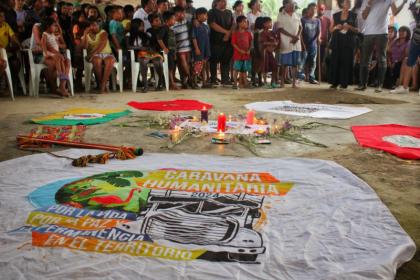
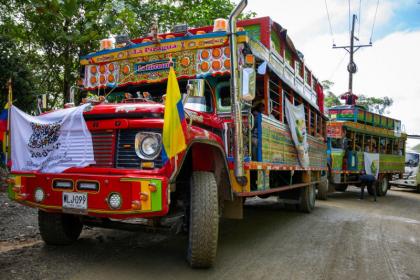
Today is the last day of the Caravan for Peace, Life and Permanence in the Territory. It has been more than four weeks travelling through the country. We started in Bogotá and went to the East of Antioquia, then to the South of Bolívar, Arauca, Chocó, Valle del Cauca and Cauca, finally arriving in Cali. We have travelled by chiva, bus and boats, traveling hundreds of kilometers.
This Caravan was promoted and supported by more than 100 national and international social organizations. In total we were 187 caravanners of 14 nationalities, who participate and all or some of the different routes. Throughout our journeys we were accompanied by at least 128 peasants, indigenous and cimarrón guards.
As internationalists, for 24 years we have been organizing and participating in Caravans and accompaniments in Colombia. The first caravan went to the South of Bolívar took place in 2001, to an area where the agro-mining communities were under paramilitary siege. The state wrongly claimed this region was uninhabited. Because of the Caravans existence over time, we have been able to verify that continuity of aggressions by paramilitarism against communities and their ways of life in this and other regions.
Today we want to highlight some of the conclusions from our observations during this Caravan. We want to draw attention to one of the most serious realities affecting the different communities. We need to talk about paramilitarism, about the rise of paramilitarism and the new strategies that the paramilitaries use to gain control of communities and dismantle communal social resistance movements, that fight to remain in their territory and to defend their dignity.
Paramilitary strategies are applied throughout the country, both in rural and urban areas, as part of a political project to retain and gain economic, social, political and territorial control (legal and illegal). This is part of a strategy of continued genocide against populations that are a hindrance to the interests of capital.
Paramilitarism is a strategy rooted in the “Nacional Security Doctrine”. It remains strong in the different territories, with variations in how it is applied in political, economic, cultural and military spheres. Murders, massacres, sexual assaults, extortion, among other attacks, continue to create fear in the communities, while denouncements continue to be met with impunity.
We have observed, and it has been asserted by the communities, that:
- Paramilitary groups are trying in many cases successfully - to gain control of the communities' organizational processes. They have infiltrated social organiztions, occupying positions in self-governing structures, such as the Community Action Boards. All this happens under the guise of social improvement aim, through human rights and community development NGOs, which serve as facades. They depend on peopleś fear, incited during several decades, in complicity with certain civil, political, military and administrative authorities.
- They harrass community leaders, making their lives impossible and forcing them leave their territories or give up the struggle.
- The prosecution of social leaders, accusations, forced disappearances, selective assassinations and sexual violence persist.
- Investigations of perpetrators of these attacks in the regions we visited continue with absolute impunity and there is no reparation for the families or their communities.
- Paramilitary groups terrorize the population, strictly controlling mobility with the threat of sanctions or assassinations. This often causes difficulties in the community in accessing alimentation and health services.
- We emphasize the formation of the Citizen Security Fronts, which, promoted by some civil authorities, generate great alarm in the communities due to their similarity to the former “Convivir”.
- We have witnessed a humanitarian crisis in the regions visited; situations of great poverty and hunger still exist. There is a lack of effective investment by the state in health and education with terrible facilities and without resources. The communities are deprived of their basic rights.
- We have seen a strong advance of paramilitary groups. Forced recruitment of young people for cannon fodder is very frequent. Youth are used to carry out attacks against facilities and people involved in social processes.
- Paramilitary groups continue to serve economic interests in the territories. They occupy the territory in order to control extractivist economies, drug trafficking, natural resources in general such as water and timber, communication and trade routes.
- We have verified that local autorities deny and normalize this paramilitary strategy.
- The proposal for the “total peace” policy is unknown in many territories.
- We have observed the environmental degradation of the areas visited: polluted rivers and the disappearance of species, due to fumigation and uncontrolled extractivism.
- The terror generated by paramilitarism in the most vulnerable communities has caused the destruction of the community fabric, of collective conscience and memory.
In this Caravan for Peace, Life and Permanence in the Territory we have suffered, at different times, harassment, even infiltrations of our activities by apparent paramilitaries.
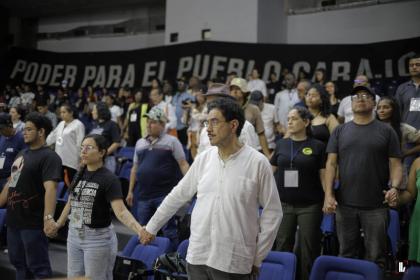
The state must guarantee the human rights of the entire population; therefore, it must implement concrete actions to enforce them. We will appeal to Colombian governmental, judicial, political and social bodies. Also to the international popular organizations and institutions of the countries where the Caravaners come from. We demand support for peace process and transparency in public and private investments in Colombia.
We prioritize the following demands made by the communities:
- Effectively invest in education (teachers, infrastructure, technology...), health, infrastructure, roads, services...
- Implement collective reparation plans accompanied by life and development plans. The reconstruction of the social and community fabric and the memory of communities must be completed.
- Implement collective and self-protection plans in communities such as indigenous, cimarrón and peasant guards, providing them with means of communication and livelihoods for their sustainability. These mechanisms must receive institutional recognition.
- An end the accusations, stigmatization and prosecution of social leaders and other members of the social movement. Stop the continued genocide against social and community processes.
- Dismantle paramilitarism in concordance with the 2016 peace agreement and with the past and current demands of the communities. Provide guarantees for community and assembly participation of communities.
- Strengthen community education systems, taking into account ethnic and gender differences and provide professional development opportunities for young people; this will help to prevent them from joining armed groups.
- A National Declaration of Crisis and Humanitarian Emergency is necessary in order for the government to implement plans and programs which address the humanitarian crisis in the territories. This should include the demining of the territories.
In October our final report will be published, detailing our observations and verifications in the territories. We will report on the projects and demands of the communities in the face of this difficult situation.
The Caravan ends, but the work of the Caravan does not end. We thank all the social organizations that, in different ways, have participated in and/or made this Caravan possible. The Caravan would not have been possible without the commitment, creativity and self-management of the communities and their organizational processes.
Many thanks
This declaration was initially published in spanish on Caravana Colombia 2024 on the 23rd of august 2024.